In short: BB defends wider because one blind is already in the pot and the call price is often lower than it looks. But the decision depends on open size, antes, opener position, effective stack, ICM and how well the hand can realize equity postflop.
What is big blind defense?
Big blind defense means choosing whether to call, 3-bet or fold against an opening raise. Because the big blind is already in the pot, calling costs less than it would from another position.
That discount does not turn every hand into a call. After calling, BB usually plays out of position, faces continuation bets often and needs to know how the range connects with different boards.
Why BB defends wider
The main reason is the call price. If an opponent opens to 2bb, the big blind has already posted 1bb and adds only 1bb to contest the pot. Antes make the pot larger and can make a wider defending range profitable.
But pot odds are only the entry point. Raw equity is not enough. You also need to consider how often the hand can reach showdown, make strong hands or draws, and bluff profitably.
What tightens BB defense
The same hand can be a standard defend against a small button open and a bad call against a strong early-position range. BB defense changes with context.
- A larger opening raise gives you worse pot odds.
- An early-position opener usually has a stronger range.
- Poor equity realization can make a call unprofitable despite attractive raw equity.
- ICM and bustout risk can tighten defense in tournaments.
- A short effective stack changes the value of calls and 3-bets.
Call, 3-bet and fold
BB defense is not only calling. Sometimes a hand performs better as a 3-bet, especially with blockers, fold equity and a clear plan against 4-bets. Sometimes a hand looks playable but should fold against a specific sizing and range.
A good review goes beyond asking, “Is this hand in the chart?” The more useful question is, “Which action works best in this spot?”
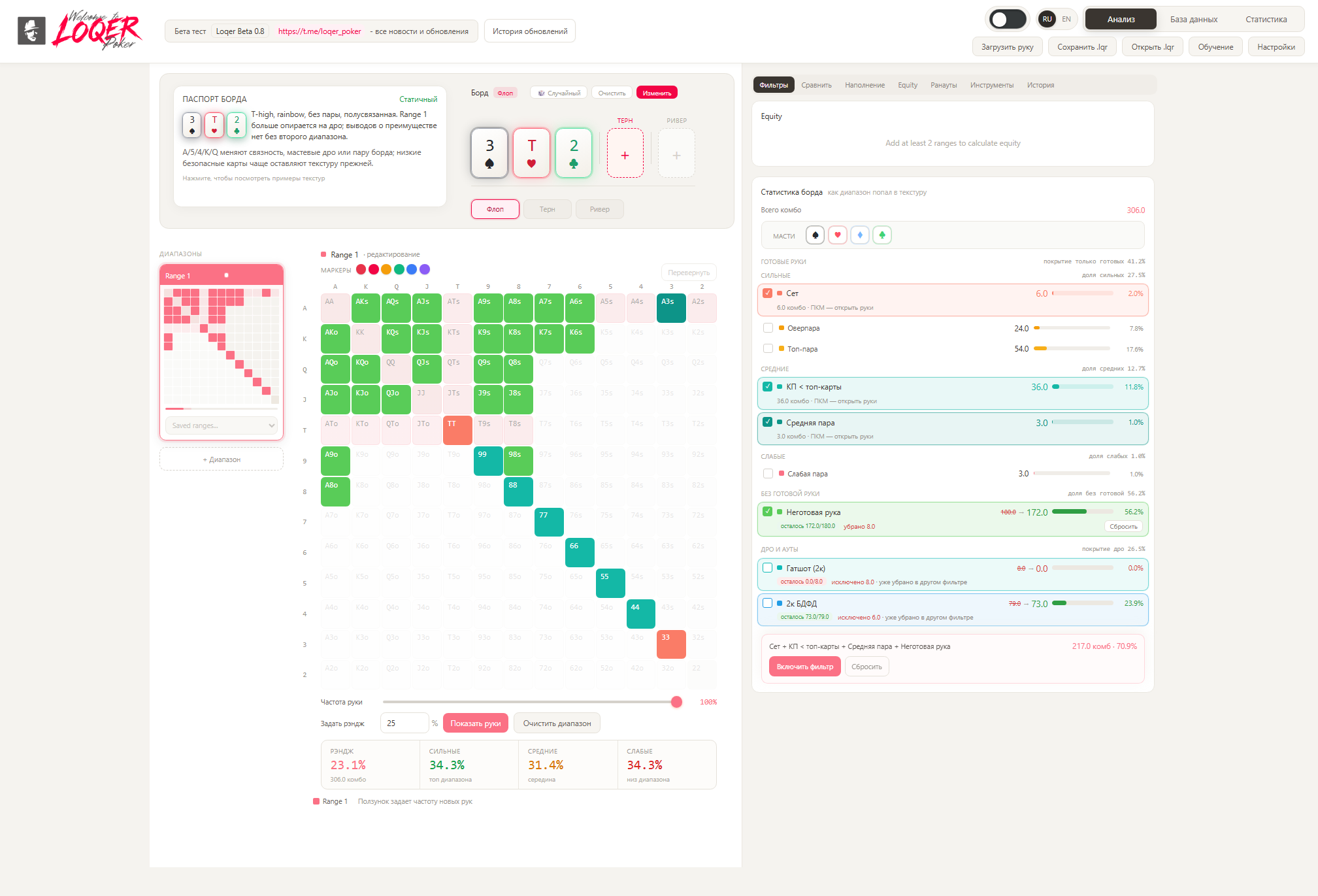
The range matrix helps show which hands defend, which hands 3-bet, how equity changes and how board texture affects the next decision.
How to review BB defense in LOQER
- Select the spot: opener position, sizing, stack and format.
- Review the opening range and BB defense range.
- Check hand EV, not only the frequency in the matrix.
- After the flop, compare how both ranges hit the board texture.
- In tournaments, check ICM, Bubble Factor and risk premium separately.
Common mistakes
- Defending too wide only because “the blind is already posted”.
- Using one chart against different open sizes.
- Overvaluing weak suited hands without a postflop plan.
- Ignoring ICM when losing the pot is more expensive than usual.
Should the big blind defend a very wide range?
Wider than other positions, but not with any two cards. How wide you can defend depends on the amount to call, your opponent’s range, antes, stack depth and how well your hand can realize its equity.
Why is BB defense wider against BTN than against UTG?
BTN usually opens wider, so more BB hands have acceptable equity and play better against that range. UTG opens tighter, so BB defense must be more careful.
When should BB 3-bet instead of call?
Consider 3-betting when a hand benefits from fold equity or useful blockers, plays well in a 3-bet pot, or struggles to realize its equity by calling out of position. The opponent’s range and response still matter.