
Short answer: a 3-bet is a raise against an existing raise. A good 3-bet range contains value hands that want calls and bluff hands that profit from fold equity, blockers and positional pressure.
What is a 3-bet?
Preflop, the first raise is an open raise. The next raise against it is a 3-bet. For example, UTG opens and CO re-raises: that is a 3-bet. If someone raises again, that is a 4-bet.
A 3-bet builds a larger pot, narrows the continuing ranges and increases the amount at stake on later streets. That is why you need to understand not only the hand, but the whole range against the opener’s range.
Value 3-bets and bluff 3-bets
Value 3-bets use hands that can get called by worse: strong pairs, strong aces and some strong broadways. Bluff 3-bets use hands that are often not good enough to call but can win immediately or have useful blockers.
The balance depends on opponent and format. Against players who fold too much to 3-bets, you can add more bluffs. Against players who call too much, the range should become more value-heavy.
- Value hands want calls from worse.
- Bluffs want folds or good playability after a call.
- Blockers reduce the chance the opponent has strong hands.
- Sizing must account for position and stack depth.
Position and 3-bet sizing
In position, a 3-bet can often be smaller because you act after the opponent postflop. Out of position, sizing is usually larger because hands realize equity worse and you want to give the opponent a less attractive price to continue.
Against short stacks, a 3-bet can quickly commit your stack. Against deep stacks, postflop playability becomes more important.
3-bets in tournaments and ICM
In tournaments, 3-bets are not only about chip EV. If a big stack covers you and short stacks are nearby, an extra 3-bet bluff can be too expensive under ICM. In a different spot, the big stack can pressure wider because opponents do not want to risk tournament life.
In PKO tournaments, some hands can 3-bet more aggressively when you cover the opponent and can win a bounty. That is why one chart cannot solve every spot.
How to review 3-bets in LOQER
In LOQER, you can set the opener’s range, mark the 3-bet range, choose a specific hand and review it against the opponent’s continuing range. Review the 3-bet as part of the full betting sequence, rather than in isolation.
Workflow: choose positions, set the open range, build the 3-bet range, check frequency, then compare close hands through equity, EV and tournament risk.
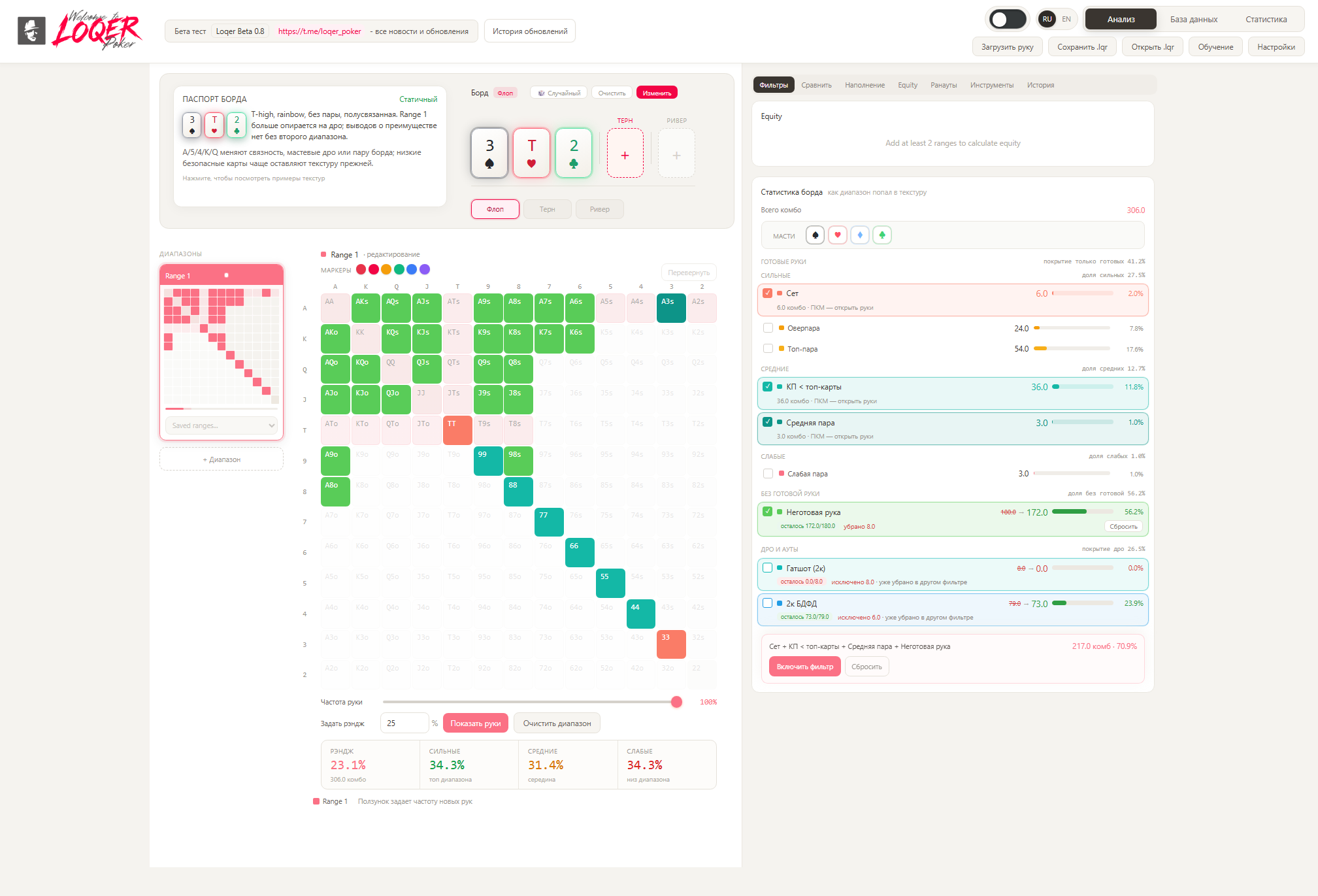
The range matrix shows which hands are value, which hands are bluffs and where the decision becomes close.
Does a 3-bet always mean a strong hand?
No. A good range contains value hands and bluffs, but the ratio changes by opponent.
Which hands make good 3-bet bluffs?
Often hands with blockers, playability or hands too weak to call but good enough to profit from fold equity.
Why 3-bet larger out of position?
Out of position, hands realize equity worse, so larger sizing reduces profitable calls and protects the range.